
 Facebook
 X
X
 Pinterest
 Copy Link
North Snohomish County Quarterly Market Trends – Q4 2020
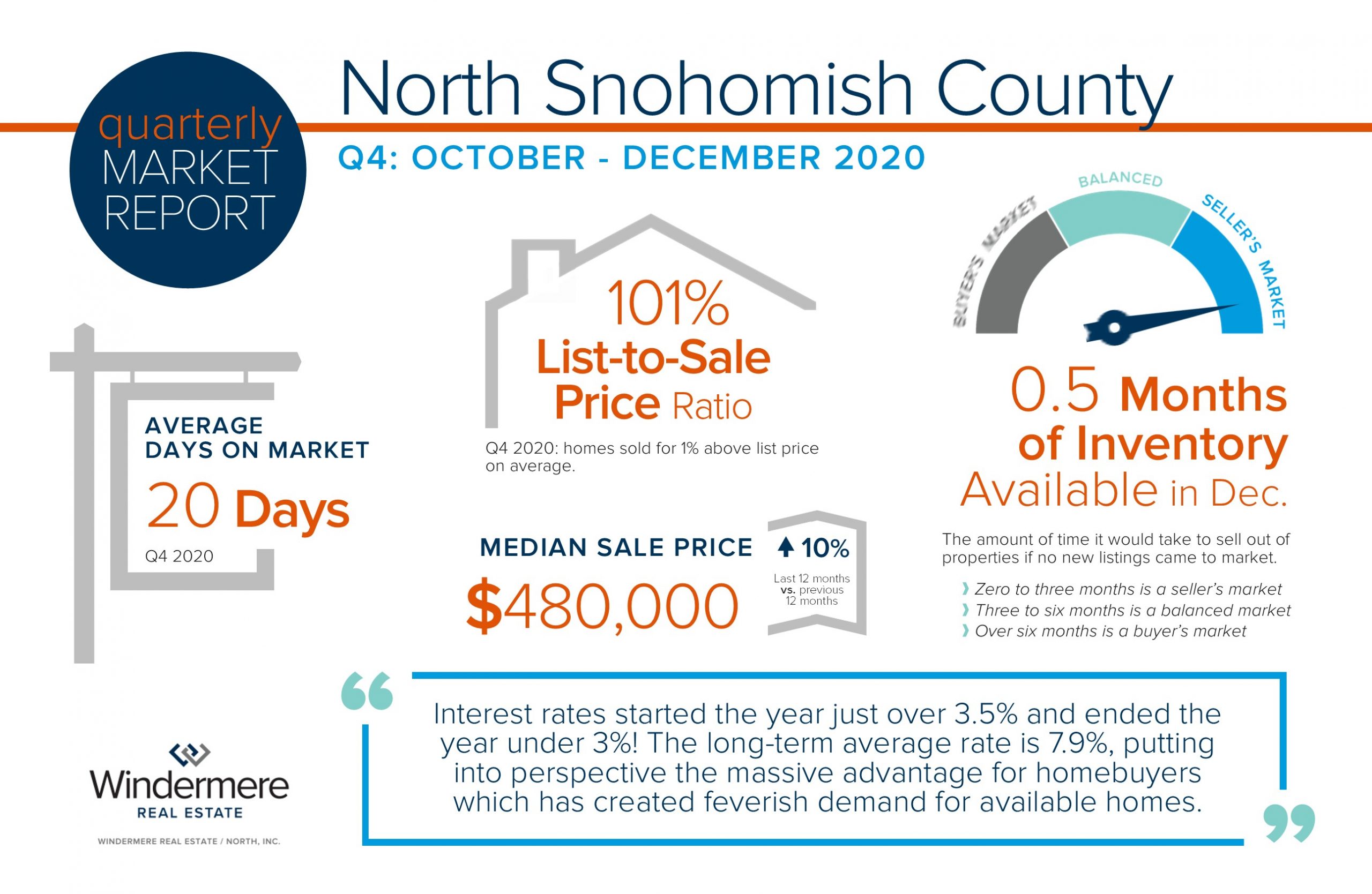
The 2020 real estate market was a bright spot in the economy and the fourth quarter finished strong, with the median price up 10% complete year-over-year. Interest rates started the year just over 3.5% and ended the year under 3%! The long-term average rate is 7.9%, putting into perspective the massive advantage for homebuyers which has created feverish demand for available homes. Even though new listings remained even year-over-year, low interest rates helped drive an 8% increase in closed sales in 2020.
Pandemic-driven moves were spurred by folks working from home, taking early retirement, and in some cases responding to job loss. Remote working eliminated the need to have a home close to work which encouraged people to flee to the suburbs. Eliminating the commute and the desire for larger spaces with outdoor enjoyment quickly moved to the top of peoples’ wish lists. The last 8 years of positive price growth has led to formidable seller equity, enabling early retirement for some and/or the opportunity to liquidate and recover from the negative effects in some employment industries.
We expect rates to stay low in 2021 and with many Millennials coming of age there will continue to be large amounts of homebuyers eagerly waiting for fresh inventory. Ending the year at 0.5 months of inventory is essentially ground zero for selection, putting home sellers in the driver’s seat for now. I will continue to keep you updated throughout 2021 as we navigate these unique times. It is my goal to help keep my clients informed and empower strong decisions; please reach out if I can help.
Goal Setting with Self-Compassion

We all know that there is no magic in the first day or month of the year, and yet we are all drawn to the idea of new beginnings. A fresh start. And so with 2020 finally put to bed, many of us are setting goals for this fresh, new year.
The topic of new year’s resolutions or goals can be a polarizing one. The fact that most people give up on or forget about their resolutions within a month or two is a widely known fact. So is it better to avoid setting goals entirely? Should we make broad, unrealistic resolutions knowing they won’t last, just to feel like we’re doing something?
If we set goals simply because we feel like we should, or because we are wishing for change in our lives, there is little chance they will be accomplished. There must be a deep-rooted reason for setting a goal so that there is lasting motivation to achieve it. They must be attainable. And we must have grace for ourselves for when we inevitably fall off the wagon.
I have put together a few thoughts to consider during this first month of 2021:
Give Yourself Grace
Arguably the most important aspect of goal setting, and for many, the most difficult. We are all going to mess up at some point. Forget to do the thing we decided to do. Skip a day. Sleep in.
The big question is – do we let our guilt paralyze us from getting back on track? Do we slip into self-pity and frustration, losing sight of our desired outcome? Enter grace. Self-compassion.
There are three important aspects to self-compassion:
- Be mindful (instead of identifying with the problem). For example, be mindful of the fact that you are struggling with exercising regularly, instead of seeing yourself as a failure at exercise.
- Connect with other people (instead of isolating yourself). For example, realize that you are probably not the only one who struggles with exercise. Talk about your struggle with people who love and support you.
- Be kind to yourself (instead of being judgmental). For example, try saying to yourself “I forgive myself for my shortcomings, and I will try again.”
Self-compassion means applying the same understanding and kindness we have for other people to ourselves. Because everyone is worthy of compassion.
Goals > Resolutions
Words matter. A resolution is a firm decision to do or not do something. A goal is the object of a person’s effort.
Setting a goal provide us with a direction to follow. Goals require intention, planning and action, but they are less rigid than all-or-nothing resolutions. Often when we are shooting for a goal, even if we do not achieve exactly what we aimed for, we will still end up closer to it than when we started. Progress in the right direction is every bit as important as hitting that goal.
Is it Necessary?
When everyone around us is making changes and launching new things, it is easy to get swept up in the feeling of needing to do something. Before making any decisions or setting goals, ask yourself if it really needs to change. Or do you just want to feel like you’re doing something?
Often, change is needed. Other times, we would be better off sticking to what we are already doing. Part of the goal-setting process should always include serious thought and research on the things in your life or business that genuinely require change or movement.
Consider the Impact
Once we have decided that something does, indeed need to change, it is important to spend some time thinking about the impact that this change will have. How will it make you feel? What will it bring to your life?
This gives us something to hold on to when we are wavering down the road. Hold tight to the feeling or the outcome this change will make in your life and keep coming back to that when things are hard.
Break it Down
Everyone’s heard this advice before, but it’s incredibly important to break our goals down into manageable bite-size pieces. Setting broad goals will inspire frustration and discouragement when they aren’t achieved. Small, specific goals are more doable, keeps us from getting overwhelmed, and each little “win” provides motivation to keep going.
If you’ve already set your 2021 goals, I invite you to reflect on what you have set, why you have set them, and how you can show self-compassion in 2021. Remember that it isn’t about changing things to fit the perfect “mold”, but figuring out what it is we really want to do. Let’s make changes in a sustainable way that allows us space to be kind to ourselves along the way.
A new year is a great opportunity to set goals and work towards change. But really, any day is an opportunity. What are you working towards today?
Monthly Newsletter – November 2020

|

|

|
 Equity levels across our nation are formidable. 42% of homeowners own their home free-and-clear and 58% of homeowners have 60% equity or more! Unlike the Great Recession of 2008 that was centered on housing, we are experiencing quite the opposite. With unemployment still an important issue, some homeowners will utilize their positive equity position to help relieve financial pressure as they pivot to an alternative career path and/or geographic location. Housing will be a tool for some to navigate the economic uncertainty the pandemic has caused.
|
|
|

|
|
|

|
Matthew Gardner Report – Q3 2020

The following analysis of the Western Washington real estate market is provided by Windermere Real Estate Chief Economist Matthew Gardner. We hope that this information may assist you with making better-informed real estate decisions. For further information about the housing market in your area, please don’t hesitate to contact your Windermere agent.
REGIONAL ECONOMIC OVERVIEW
Employment numbers in Western Washington continue to improve following the massive decline caused by COVID-19. For perspective, the area shed more than 373,000 jobs between February and April. However, the recovery has been fairly robust: almost 210,000 of those jobs have returned. Unemployment levels remain elevated; the current rate is 8.2%. That said, it is down from 16.6% in April. The rate, of course, varies across Western Washington counties, with a current low of 7.2% in King County and a high of 11.2% in Grays Harbor County. The economy is healing, but the pace of improvement has slowed somewhat, which is to be expected. That said, I anticipate that jobs will continue to return as long as we do not see another spike in new infections.
HOME SALES
- Sales continued to improve following the COVID-19-related drop in the first quarter of the year. There were 25,477 transactions in the quarter, an increase of 11.6% from the same period in 2019, and 45.9% higher than in the second quarter of this year.
- Listing activity remains woefully inadequate, with total available inventory 41.7% lower than a year ago, but 1.6% higher than in the second quarter of this year.
- Sales rose in all but two counties, though the declines were minimal. The greatest increase in sales was in San Juan County, which leads one to wonder if buyers are actively looking in more isolated markets given ongoing COVID-19-related concerns.
- Pending sales—a good gauge of future closings—rose 29% compared to the second quarter of the year, suggesting that fourth quarter closings will be positive.

HOME PRICES
- Home-price growth in Western Washington rose a remarkable 17.1% compared to a year ago. The average sale price was $611,793.
- When compared to the same period a year ago, price growth was strongest in Mason, Island, and San Juan counties. Only one county saw prices rise by less than ten percent.
- It was even more impressive to see the region’s home prices up by a very significant 9.4% compared to the second quarter of 2020. It is clear that low mortgage rates, combined with limited inventory, are pushing prices up.
- As long as mortgage rates stay low, and there isn’t an excessive spike in supply (which is highly unlikely), prices will continue to rise at above-average rates. That said, if this continues for too long, we will start to face affordability issues in many markets.

DAYS ON MARKET
- The average number of days it took to sell a home in the third quarter of this year dropped two days compared to a year ago.
- Snohomish County was the tightest market in Western Washington, with homes taking an average of only 16 days to sell. All but two counties—Lewis and San Juan—saw the length of time it took to sell a home rise compared to the same period a year ago.
- Across the region, it took an average of 36 days to sell a home in the quarter. It is also worth noting that it took an average of 4 fewer days to sell a home than in the second quarter of this year.
- The takeaway here is that significant increases in demand, in concert with remarkably low levels of inventory, continue to drive market time lower.

CONCLUSIONS

This speedometer reflects the state of the region’s real estate market using housing inventory, price gains, home sales, interest rates, and larger economic factors.
High demand, favorable interest rates, and low supply clearly point to a seller’s market in Western Washington. As such, I am moving the needle even more in favor of sellers.
As I suggested earlier in this report, although the market is remarkably buoyant, I am starting to see affordability issues increase in many areas—not just in the central Puget Sound region—and this is concerning. Perhaps the winter will act to cool the market, but something is telling me we shouldn’t count on it.
ABOUT MATTHEW GARDNER
 As Chief Economist for Windermere Real Estate, Matthew Gardner is responsible for analyzing and interpreting economic data and its impact on the real estate market on both a local and national level. Matthew has over 30 years of professional experience both in the U.S. and U.K.
In addition to his day-to-day responsibilities, Matthew sits on the Washington State Governors Council of Economic Advisors; chairs the Board of Trustees at the Washington Center for Real Estate Research at the University of Washington; and is an Advisory Board Member at the Runstad Center for Real Estate Studies at the University of Washington where he also lectures in real estate economics.
South King County Quarterly Market Trends – Q3 2020
The real estate market continued to positively perform in the third quarter, and is the bright light in the economy during the COVID-19 health crisis. The protocols in place that have helped protect the safety of the community have recently been expanded to allow small group open houses to help address the demand in the market.
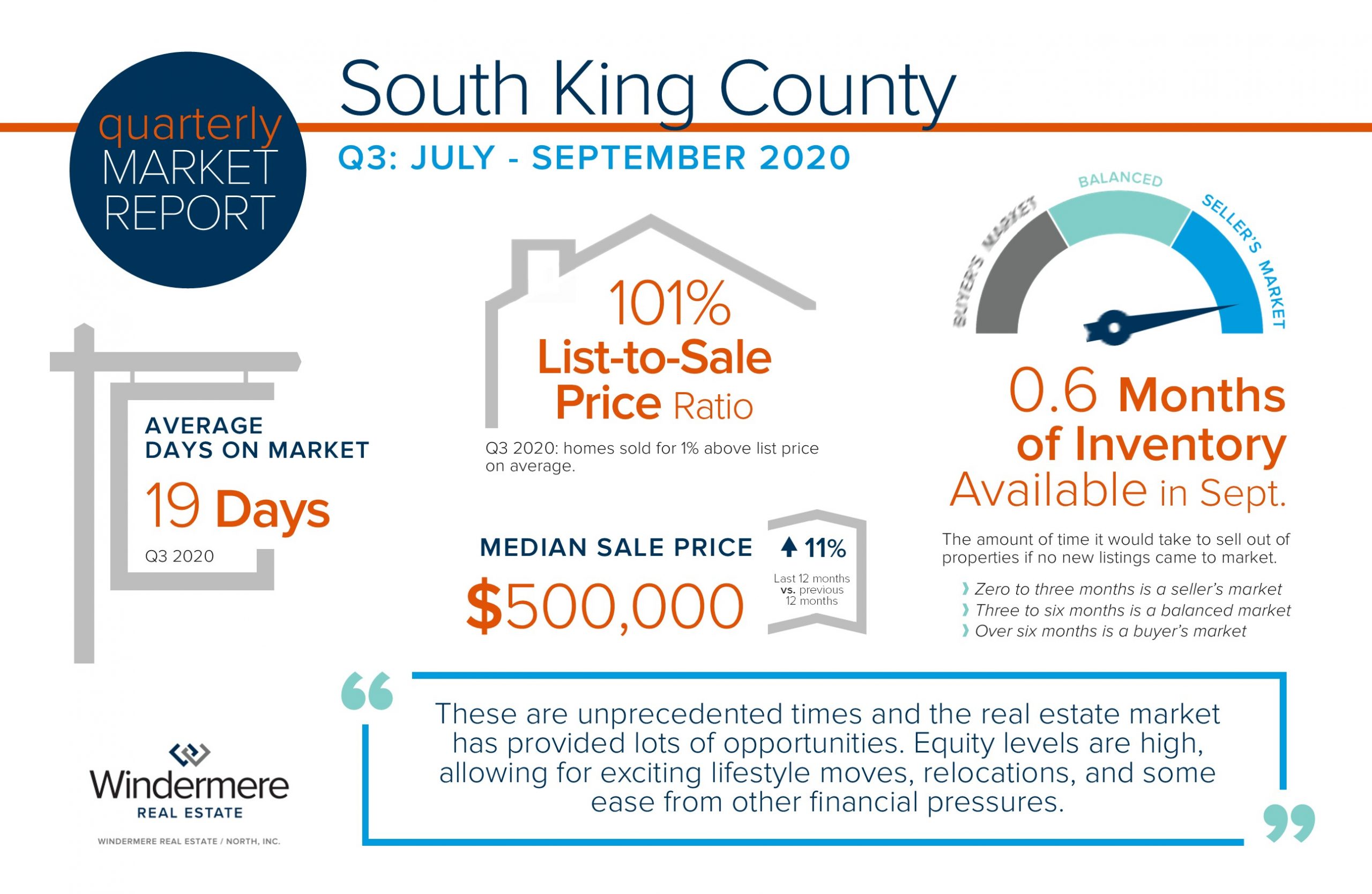
Interest rates remain historically low, hovering around 3% and creating robust buyer demand and a competitive marketplace. Coupled with available inventory being down 55% complete year-over-year, the third quarter saw many home sales escalate in price due to multiple offers. This perfect storm of supply and demand has amped up price appreciation. With only 0.6 months of available inventory based on pending sales, the median price is up 11% complete year-over-year.
Inventory is down due to the high absorption rate which resulted in many sales. There was a delay in homes coming to market in the spring, but the summer months got us within 5% of the previous year’s number of new listings. The influence of interest rates, along with many people making big lifestyle moves due to working from home, Baby Boomers retiring, and the younger generations transitioning their work and family statuses have resulted in just 2% fewer sales complete year-over-year.
These are unprecedented times and the real estate market has provided lots of opportunities. Equity levels are high, allowing for exciting lifestyle moves, relocations, and some ease from other financial pressures. It is my goal to help keep my clients informed and empower strong decisions, now more than ever. Please reach out if you’d like to discuss your real estate goals and how they relate to your lifestyle and bottom line. Be well!
Eastside Quarterly Market Trends – Q3 2020
The real estate market continued to positively perform in the third quarter, and is the bright light in the economy during the COVID-19 health crisis. The protocols in place that have helped protect the safety of the community have recently been expanded to allow small group open houses to help address the demand in the market.
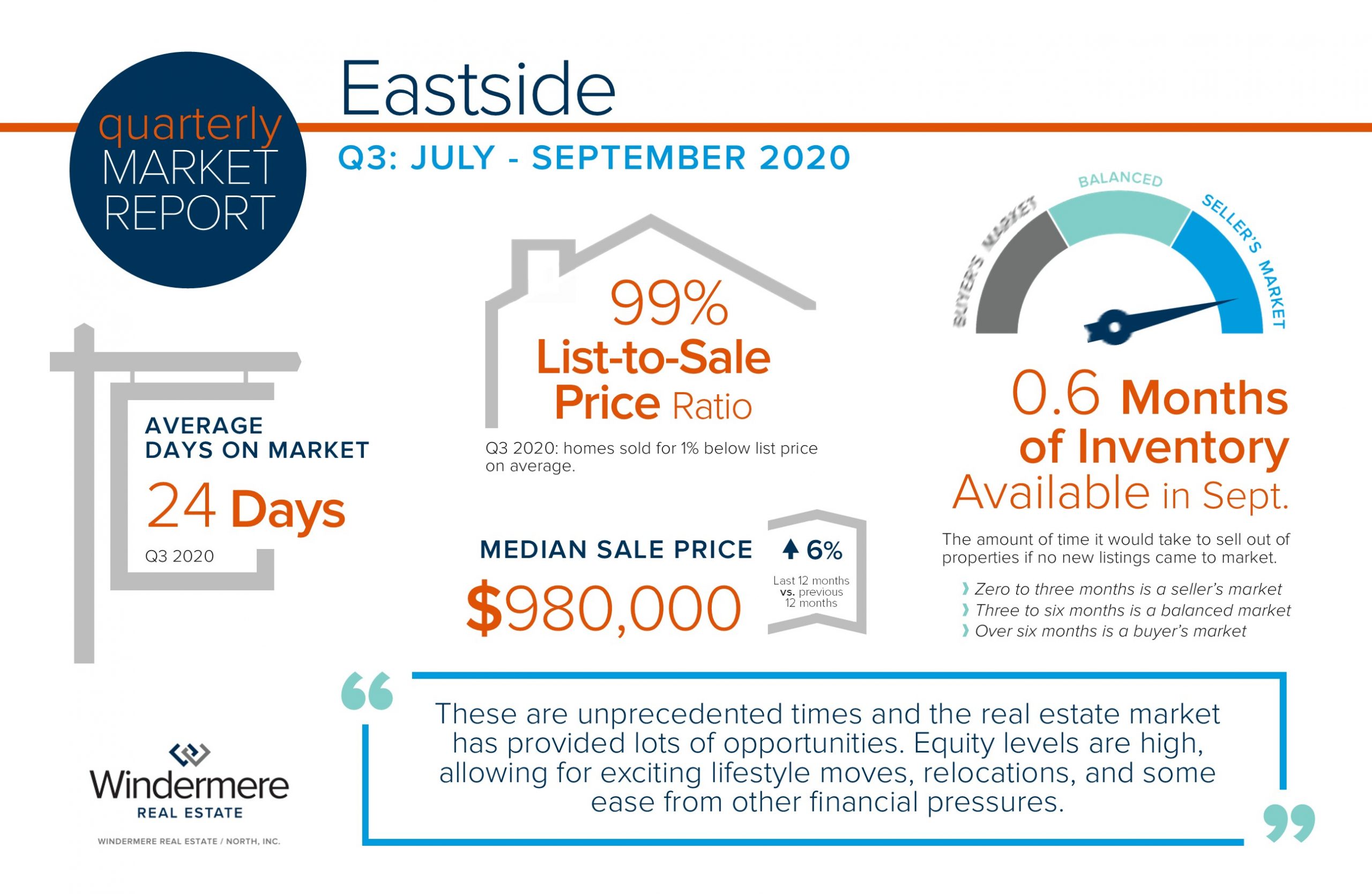
Interest rates remain historically low, hovering around 3% and creating robust buyer demand and a competitive marketplace. Coupled with available inventory being down 58% complete year-over-year, the third quarter saw many home sales escalate in price due to multiple offers. This perfect storm of supply and demand has amped up price appreciation. With only 0.6 months of available inventory based on pending sales, the median price is up 6% complete year-over-year.
Inventory is down due to the high absorption rate which resulted in many sales. There was a delay in homes coming to market in the spring, but the summer months got us within 12% of the previous year’s number of new listings. The influence of interest rates, along with many people making big lifestyle moves due to working from home, Baby Boomers retiring, and the younger generations transitioning their work and family statuses have resulted in only 4% fewer sales complete year-over-year.
These are unprecedented times and the real estate market has provided lots of opportunities. Equity levels are high, allowing for exciting lifestyle moves, relocations, and some ease from other financial pressures. It is my goal to help keep my clients informed and empower strong decisions, now more than ever. Please reach out if you’d like to discuss your real estate goals and how they relate to your lifestyle and bottom line. Be well!
Seattle Metro Quarterly Market Trends – Q3 2020
The real estate market continued to positively perform in the third quarter, and is the bright light in the economy during the COVID-19 health crisis. The protocols in place that have helped protect the safety of the community have recently been expanded to allow small group open houses to help address the demand in the market.
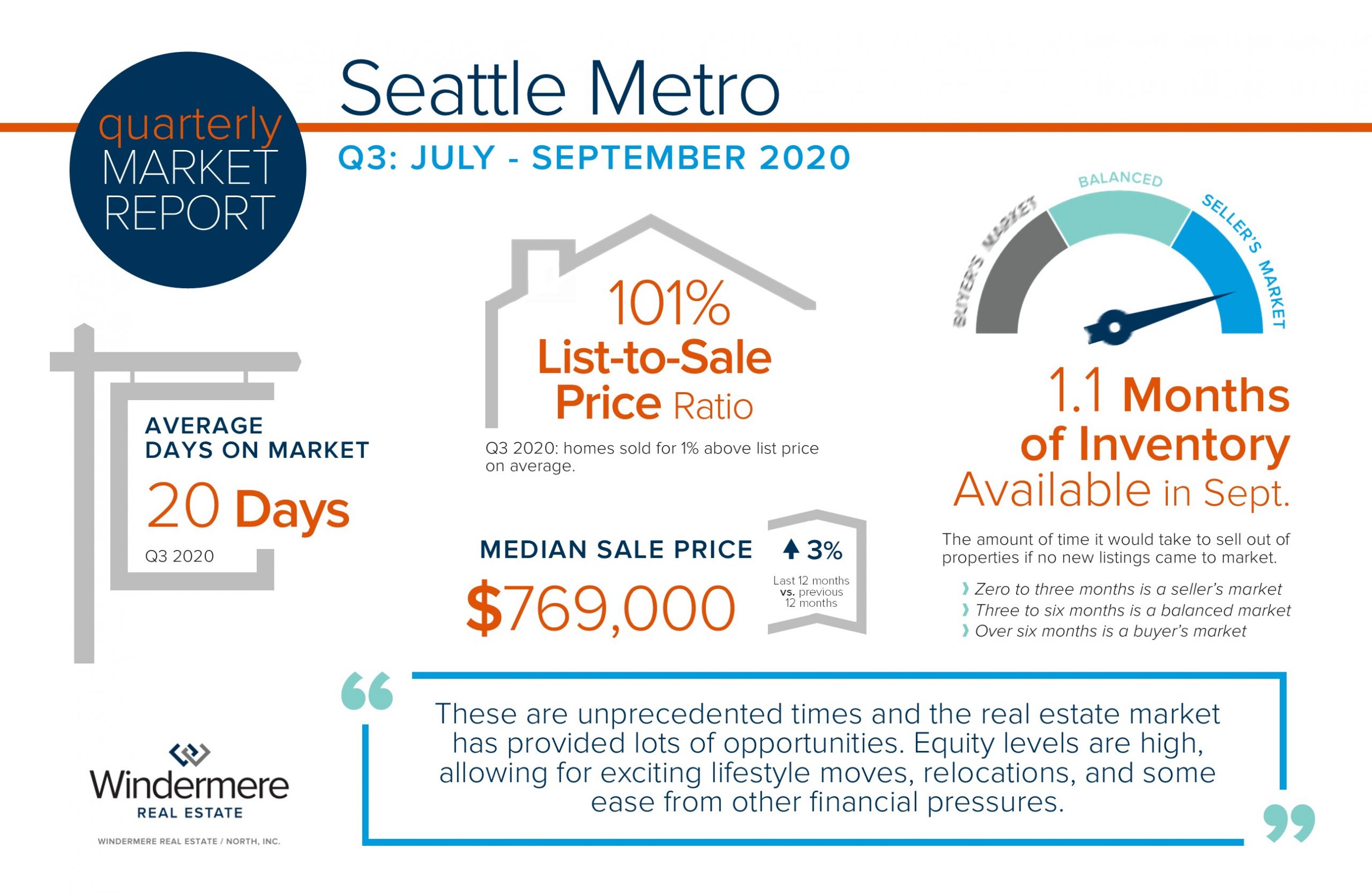
Interest rates remain historically low, hovering around 3% and creating robust buyer demand and a competitive marketplace. Coupled with available inventory being down 17% complete year-over-year, the third quarter saw many home sales escalate in price due to multiple offers. This perfect storm of supply and demand has maintained price appreciation. With only 1.1 months of available inventory based on pending sales, the median price is up 3% complete year-over-year.
Inventory is down due to the high absorption rate which resulted in many sales. There was a delay in homes coming to market in the spring, but the summer months got us equal with the previous year’s number of new listings. The influence of interest rates, along with many people making big lifestyle moves due to working from home, Baby Boomers retiring, and the younger generations transitioning their work and family statuses have resulted in 10% more sales complete year-over-year.
These are unprecedented times and the real estate market has provided lots of opportunities. Equity levels are high, allowing for exciting lifestyle moves, relocations, and some ease from other financial pressures. It is my goal to help keep my clients informed and empower strong decisions, now more than ever. Please reach out if you’d like to discuss your real estate goals and how they relate to your lifestyle and bottom line. Be well!
North King County Quarterly Market Trends – Q3 2020
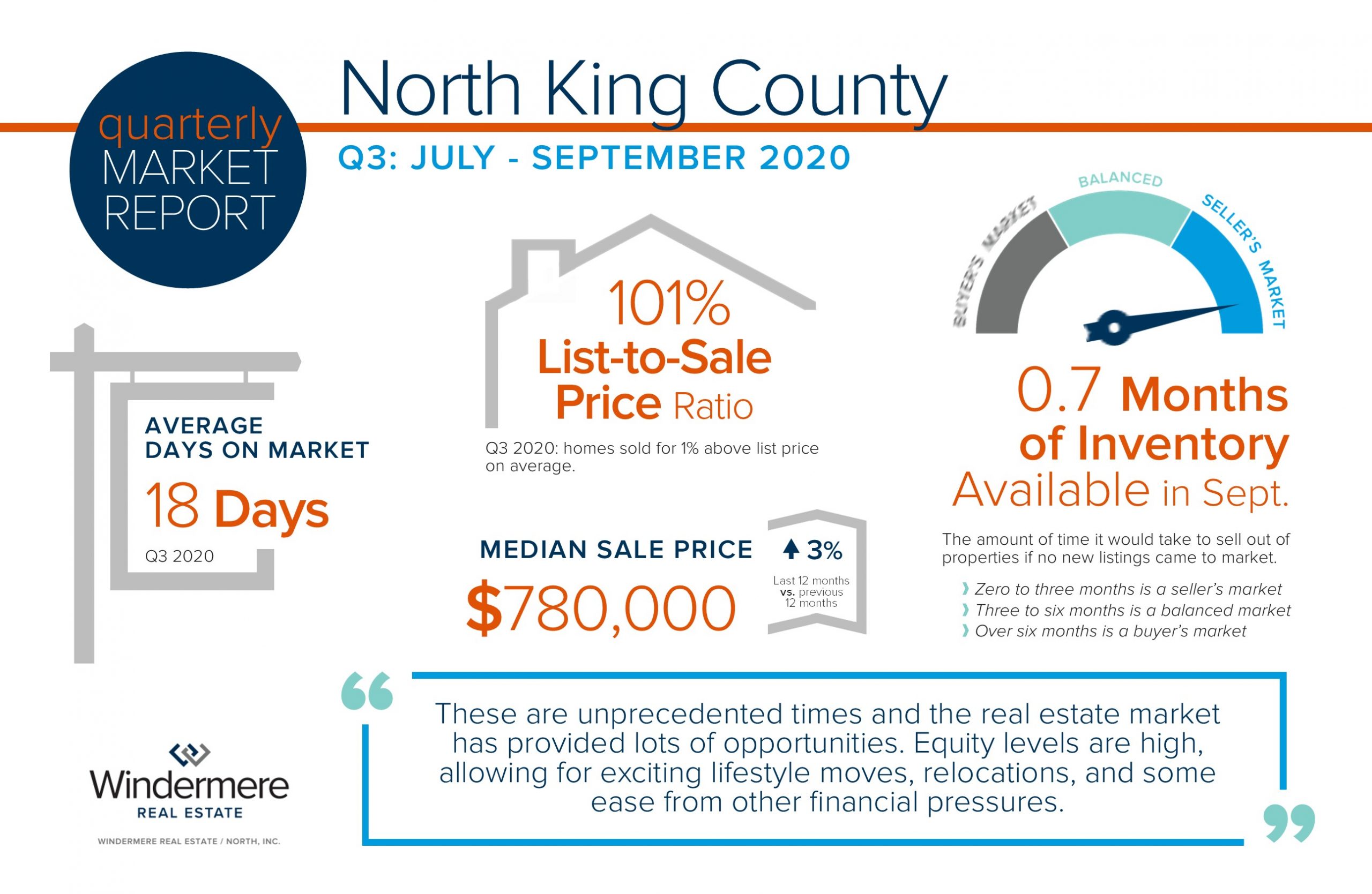
The real estate market continued to positively perform in the third quarter, and is the bright light in the economy during the COVID-19 health crisis. The protocols in place that have helped protect the safety of the community have recently been expanded to allow small group open houses to help address the demand in the market.
Interest rates remain historically low, hovering around 3% and creating robust buyer demand and a competitive marketplace. Coupled with available inventory being down 45% complete year-over-year, the third quarter saw many home sales escalate in price due to multiple offers. This perfect storm of supply and demand has maintained price appreciation. With only 0.7 months of available inventory based on pending sales, the median price is up 3% complete year-over-year.
Inventory is down due to the high absorption rate which resulted in many sales. There was a delay in homes coming to market in the spring, but the summer months got us within 6% of the previous year’s number of new listings. The influence of interest rates, along with many people making big lifestyle moves due to working from home, Baby Boomers retiring, and the younger generations transitioning their work and family statuses have resulted in 6% more sales complete year-over-year.
These are unprecedented times and the real estate market has provided lots of opportunities. Equity levels are high, allowing for exciting lifestyle moves, relocations, and some ease from other financial pressures. It is my goal to help keep my clients informed and empower strong decisions, now more than ever. Please reach out if you’d like to discuss your real estate goals and how they relate to your lifestyle and bottom line. Be well!
South Snohomish County Quarterly Market Trends – Q3 2020
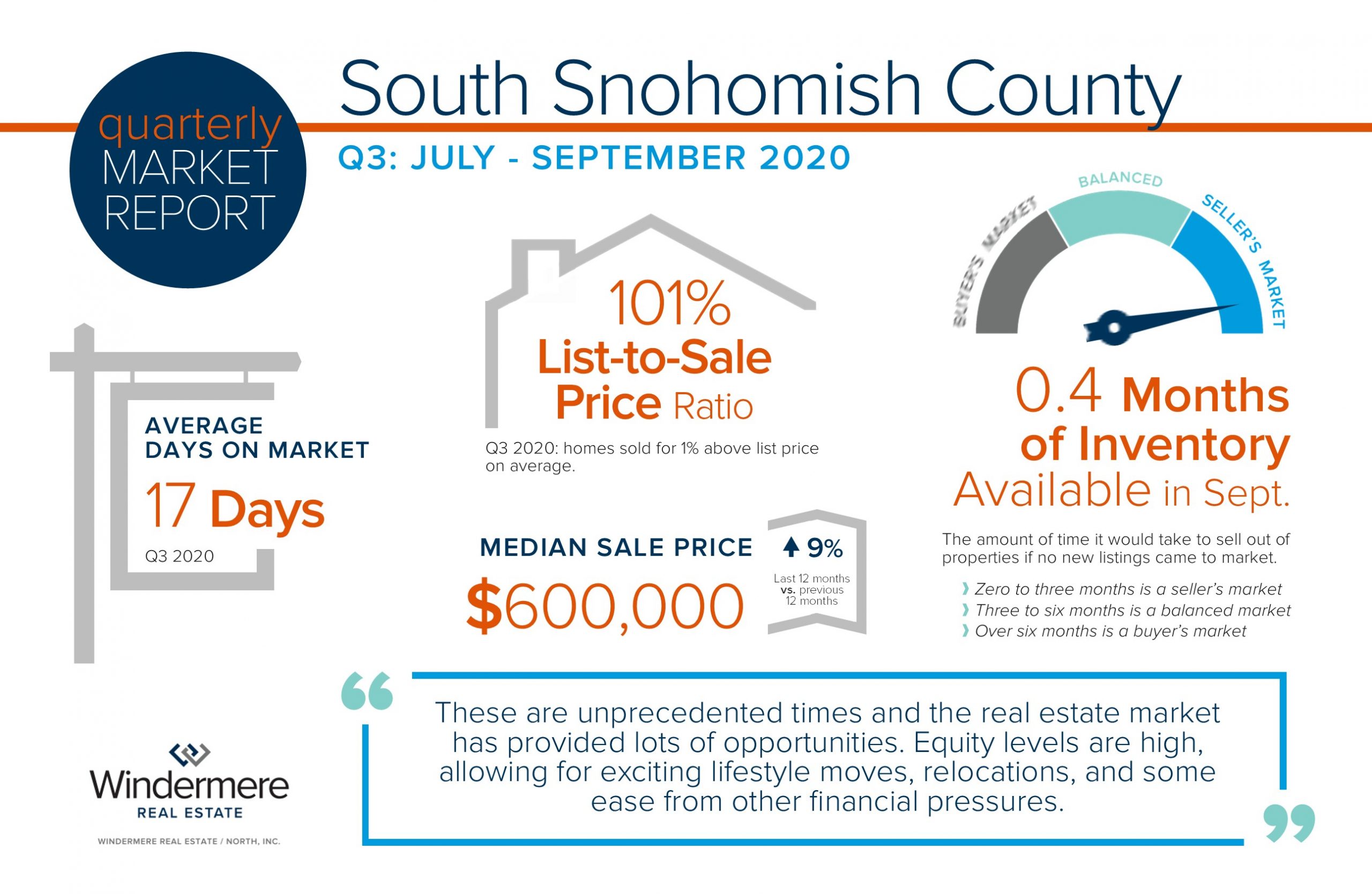
The real estate market continued to positively perform in the third quarter, and is the bright light in the economy during the COVID-19 health crisis. The protocols in place that have helped protect the safety of the community have recently been expanded to allow small group open houses to help address the demand in the market.
Interest rates remain historically low hovering around 3% and creating robust buyer demand and a competitive marketplace. Coupled with available inventory being down 72% complete year-over-year, the third quarter saw many home sales escalate in price due to multiple offers. This perfect storm of supply and demand has amped up price appreciation. With only 0.4 months of available inventory based on pending sales, the median price is up 9% complete year-over-year.
Inventory is down due to the high absorption rate which resulted in many sales. There was a delay in homes coming to market in the spring, but the summer months got us within 10% of the previous year’s number of new listings. The influence of interest rates, along with many people making big lifestyle moves due to working from home, Baby Boomers retiring, and the younger generations transitioning their work and family statuses have resulted in only 3% fewer sales complete year-over-year.
These are unprecedented times and the real estate market has provided lots of opportunities. Equity levels are high, allowing for exciting lifestyle moves, relocations, and some ease from other financial pressures. It is my goal to help keep my clients informed and empower strong decisions, now more than ever. Please reach out if you’d like to discuss your real estate goals and how they relate to your lifestyle and bottom line. Be well!
North Snohomish County Quarterly Market Trends – Q3 2020
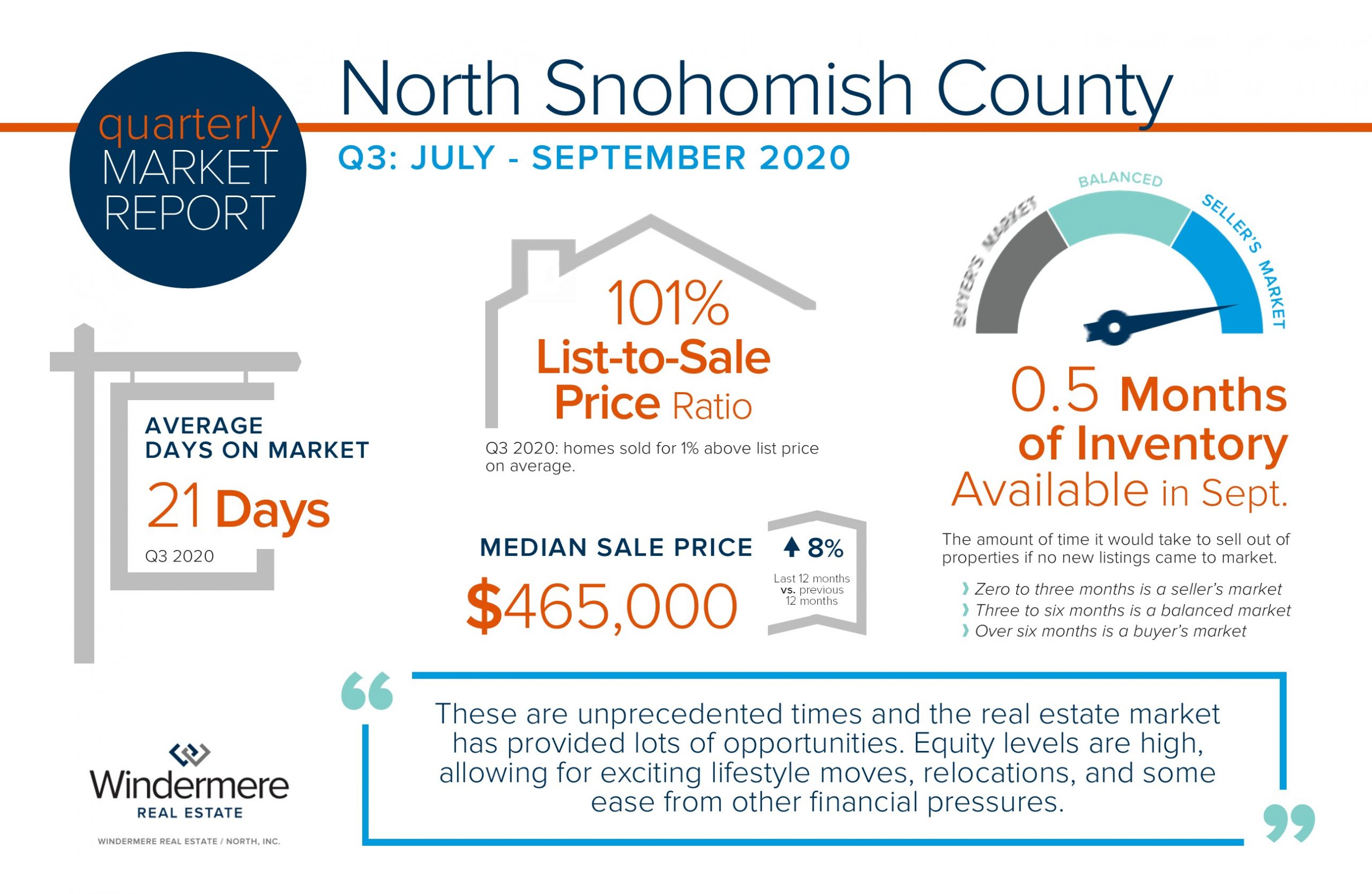
The real estate market continued to positively perform in the third quarter, and is the bright light in the economy during the COVID-19 health crisis. The protocols in place that have helped protect the safety of the community have recently been expanded to allow small group open houses to help address the demand in the market.
Interest rates remain historically low, hovering around 3% and creating robust buyer demand and a competitive marketplace. Coupled with available inventory being down 55% complete year-over-year, the third quarter saw many home sales escalate in price due to multiple offers. This perfect storm of supply and demand has amped up price appreciation. With only 0.5 months of available inventory based on pending sales, the median price is up 8% complete year-over-year.
Inventory is down due to the high absorption rate. There was a delay in homes coming to market in the spring, but the summer months finally caught us up with the previous year’s number of new listings. The influence of interest rates, along with many people making big lifestyle moves due to working from home, Baby Boomers retiring, and the younger generations transitioning their work and family statuses have resulted in 6% more sales complete year-over-year.
These are unprecedented times and the real estate market has provided lots of opportunities. Equity levels are high, allowing for exciting lifestyle moves, relocations, and some ease from other financial pressures. It is my goal to help keep my clients informed and empower strong decisions, now more than ever. Please reach out if you’d like to discuss your real estate goals and how they relate to your lifestyle and bottom line. Be well!
